Wednesday, 30 July 2025

House fire - Welling 🔥

Six fire engines and around 40 firefighters tackled a house fire on Okehampton Crescent in Welling.


A small part of the roof of the two storey semi detached house was damaged by the fire. One woman left the property before the Brigade arrived. No injuries were reported.


The fire is believed to have been accidental and was caused by hot works taking place at the property. Hot works tend to involve an open flame, or are activities that can produce heat and sparks capable of starting a fire.


A 32-metre turntable ladder was deployed to help extinguish the fire from height.


The Brigade’s 999 Control officers received their first call regarding the fire at 1315 and the fire was extinguished by1550. Crews from Sidcup, East Greenwich, Greenwich, Eltham, Lewisham and Orpington fire stations attended the scene.


Source: LFB (28/07/2025)

Tuesday, 29 July 2025

Stop! Think Before You Tap 'Consent' – Why Sharing Your Data with Smartphone Apps Might Be a Bad Idea

We've all been there. You download a shiny new app – a game, a fitness tracker, a social media platform – and immediately you're met with a barrage of permission requests. "Allow access to your location?" "Grant permission to your photos?" "Consent to data sharing with third parties?" In our eagerness to get started, it's all too easy to tap "Accept" without a second thought. But here in the UK, with our strong data protection laws like the UK GDPR, it's more crucial than ever to understand why blindly consenting to data sharing by smartphone apps can be a significant risk.

The Hidden World of Your Data

Your smartphone is a goldmine of personal information. From your contacts and photos to your location history, Browse habits, and even your health data, these apps can collect an astonishing amount of detail about your life. When you consent to data sharing, you're essentially handing over the keys to this treasure trove.

But where does that data go? Often, it's not just the app developer who gets to see it. Many apps share your information with "third parties" – these can be advertising networks, data brokers, or even other companies you've never heard of. The purpose? To build detailed profiles about you, which can then be used for targeted advertising, market research, or even sold on to other entities.

The Risks Are Real

So, what are the potential downsides of this widespread data sharing?

  • Loss of Privacy: This is the most obvious one. Do you really want companies you don't know to have a complete picture of your daily routine, your friends, your interests, and even your most private moments? This data can be combined and analysed to reveal surprisingly intimate details about your life.

  • Targeted Advertising Overload: While some might not mind seeing "relevant" ads, others find the constant tracking and highly personalised ads intrusive and even manipulative. Your data is being used to influence your purchasing decisions, and often, without you truly understanding the extent of it.

  • Security Vulnerabilities: Every time your data is shared, it creates another potential point of vulnerability. If a third-party company that holds your data experiences a data breach, your personal information could be exposed to hackers, leading to identity theft, fraud, or other malicious activities.

  • Data Misuse and Unforeseen Consequences: What if your health data is used to deny you insurance? Or your location data is used to track your movements without your explicit knowledge or consent for purposes beyond what you originally agreed to? Once your data is out there, it's incredibly difficult to control how it's used in the future.

  • Less Control Over Your Digital Footprint: In an age where our digital footprint is becoming increasingly significant, giving away control of your data makes it harder to manage your online reputation and privacy.

What Can You Do?

The good news is that you have rights under UK data protection laws, and you can take steps to protect your data:

  1. Read the Permissions Carefully: Before you download an app, check the permissions it requests. Does a simple photo editing app really need access to your microphone or contacts? If something seems excessive, reconsider downloading it.

  2. Scrutinise Privacy Policies: We know, they're long and often full of legal jargon. But try to skim the sections on "data collection," "data sharing," and "third parties." Look for information on how to delete your data if you stop using the app.

  3. Limit or Revoke Permissions: You can always adjust app permissions after installation. Go into your smartphone's settings (usually under "Apps" or "Privacy") and review what each app has access to. You can revoke permissions you're uncomfortable with, though be aware that some app features might be affected.

  4. Check In-App Privacy Settings: Many apps have their own privacy settings within the app itself. Explore these to see if you can limit data tracking, revoke consent for certain types of sharing, or adjust ad personalisation.

  5. Delete Unused Apps: If you're no longer using an app, delete it. This stops any ongoing data collection and reduces the risk of your data being exposed through inactive accounts. Remember to check if the app offers a way to delete your account data entirely, not just the app from your phone.

  6. Be Wary of "Free" Services: If an app is free, chances are its business model relies on collecting and monetising your data. Be extra cautious with these.

In the UK, the Information Commissioner's Office (ICO) provides guidance and regulations to ensure app developers handle your data responsibly. But ultimately, the first line of defence is you. By being mindful of what you consent to, you can take significant steps towards safeguarding your digital privacy.

So next time an app asks for permission to share your data, hit pause. Ask yourself: Is this really necessary? Do I trust this company with my information? Your privacy is worth more than a quick tap.


Monday, 28 July 2025

Hospital fire - Sidcup 🔥

Four fire engines and around 25 firefighters tackled a fire at a hospital block under refurbishment on Frognal Avenue in Sidcup.

A storage room was destroyed by the fire. There were no reports of any injuries. 

Control Officers took the first of three calls at 0342 and mobilised crews from Sidcup, Eltham, Orpington and surrounding fire stations to the scene. The fire was extinguished by 0528.

The cause of the fire is under investigation.

Source: LFB (27/07/2025) 


Friday, 25 July 2025

Derelict building fire - Sidcup 🔥

Eight fire engines and around 60 firefighters have been called to a fire on Heron Crescent in Sidcup.

The roof of a two-storey derelict building was fully alight. Part of the first floor was also damaged by fire. There were no reports of any injuries.

Local residents were advised to keep windows and doors closed due to large amounts of smoke being produced.

Drivers were warned to expect some traffic disruption in the area, including on Main Road.

The Brigade received the first of eight calls at 1331 and Control Officers mobilised crews from Orpington, Bromley, Lee Green and surrounding fire stations to the scene. A 32-metre turntable ladder from Greenwich Fire Station has also been in attendance and used as a water tower to help extinguish the fire from above. It has also been deployed as an observation tower to provide the Incident Commander with a greater situational awareness of the incident, along with a drone. The fire was brought under control by 1548.

The cause of the fire is under investigation by the Brigade and Metropolitan Police.
Source: LFB (23/07/2-25)

Artificial intelligence scams are circulating

Last year, we exposed a global financial scam called Quantum AI, which uses artificial intelligence technology to impersonate well-known people, aiming to lure victims into dodgy investment schemes.

The scam has reappeared in recent weeks – we found 12 ads posted on Facebook and Instagram promoting Quantum AI. Take a look at these dodgy ads and find out how to avoid this type of scam.

Stay ahead of the scammers
 
Source: Which? (24 Jul 2025) 

Beware dodgy Dragons' Den ads

We found 62 ads online claiming to sell Nixol (a weight-loss pill) which either included Dragons' Den logos, were posted from accounts called 'Dragon’s Den' or used the image of the well-known Dragon, Deborah Meaden.

We examine two examples of these ads, explain what we found and how you can avoid buying these dodgy products.

See what these scams look like
 
Source: Which? (24 Jul 2025) 

Amazon account hacking scam

We heard from someone who had their Amazon account hacked and a bill of £650 racked up by scammers. The victim only noticed when emails started appearing daily in their inbox, with details of the products being ordered without their knowledge.

Our scams expert, Faye Lipson, explains the warning signs to look out for and how to secure your online accounts against hackers.

Keep your online accounts secure
 
Source: Which? (23 Jul 2025) 

Thursday, 24 July 2025

SCAMARAMA: The 5 Most Convincing Scams of 2025

The usual warning signs are getting harder to spot. They said they didn't see it coming. They said they never thought it would happen to them. These scams are so believable because they exploit our everyday needs and worries.
 

In some examples, fraudsters even try to make you feel sorry for them to get what they want. All it takes is a cunningly crafted message or a coincidental opportunity that catches you out on a busy day.

Here, we take a look at the five most convincing scams and share advice on what to watch out for.

(A version of this article was originally published in Which? Tech magazine.)

1. Big Brand Giveaways

Fraudsters know their audience and lurk in social media feeds with fake giveaways intended to lure you into handing over your personal information, and even money, for prizes that don’t exist.

Often disguising themselves as popular brands, they run competitions for everything from store vouchers to phones, toys, and cars. Bogus competitions can also simply be well-designed images using a brand’s logo, posted from a throwaway account that clearly has no link to a real brand.

Another tactic popular with scammers is posting recommendations or endorsements about competitions or offers from accounts of real individuals whose accounts they’ve hacked. Posts that appear to be from real people give these scams an extra convincing illusion of authenticity.

Competitions can also be a quick method of stealing money. Sandra told us that she was delighted to hear she had won a 55-inch TV after entering a Facebook competition she thought was being run by Currys. She was asked to pay £15 for delivery because it was a large item and would need two delivery drivers. But after she’d paid using an online form, the contact stopped. The scammers disappeared with her money, her address, and her bank details.

Spot the scam: Trusted brands would never ask you to pay a penny to receive a prize. Before entering any competition online, you can make a few checks before giving away any personal information.


2. Energy Bill Texts

With energy bills skyrocketing and Winter Fuel Payment announcements, scammers are taking advantage of ongoing worry and confusion to try to con people into handing over personal and payment information.

The fake messages either claim to be from the government or sometimes from your local council, claiming you’re entitled to, or have been ‘approved’ to, receive a heating allowance or subsidies. The wording can be formal, making the message seem official. The messages include links to take victims to fake websites that may be designed to look like gov.uk or your local council website. There are also plenty of online ads circulating on social media and websites that also promise authority-funded heating allowances and other relief payments and tax breaks for certain people.

Spot the scam: Most people eligible for the Winter Fuel Payment get the payment automatically, and there’s no need to apply for it. Be wary of texts claiming to be from trusted organisations that contain links to websites asking for personal information.


3. Job Scams

Scammers offering highly paid, remote work are nothing new, but since working from home has become more widespread, these offers can seem plausible. They’re often promoted as 'work from anywhere' opportunities that also offer a lucrative salary for a role that requires little or no expertise, experience, or qualifications, and require less time than typical jobs.

Scammers even share elaborate fake case studies showcasing other people who have apparently taken on similar roles and are now living the high life. On Instagram and Facebook, scammers may drop into your direct messages, claiming that they’re fans of your photos or videos, and ask for a partnership or offer you paid work or freebies with the intention of conning you.

Spot the scam: Job scammers tend to grab your attention with get-rich-quick opportunities, hire quickly, and ask few questions. Above all, they show a keen interest in getting hold of your bank details or money. It’s a red flag if someone who claims to be a recruiter starts acting unprofessionally, such as harassing you for unnecessary personal information upfront or making threats.


4. Fake Closing-Down Sales

A store closure sale where ‘everything must go’ is a perfect ruse for scammers. They create a sense of immediacy and urgency to buy into deals too good to be missed.

A tactic currently popular with scammers is posting an emotive sob story on social media. This is usually a heart-wrenching message claiming something along the lines that their small business is going bust because of increasing business costs, or they’ve had to close it for tragic or personal reasons. Anyone interested in buying stock is invited to bid on or buy items informally via bank transfer, PayPal, or gift vouchers from other retailers.

Fraudsters also take advantage when well-known retailers are struggling or closing down. For example, when New Look closed its stores in Northern Ireland, scammers targeted Facebook users across the UK with a fake ‘mystery bag’ offer. The ads promised a haul of £500-worth of clearance items for just £10, which one person told us they unwittingly snapped up because the offer seemed to make sense at the time.

Spot the scam: Before you buy, check the accounts promoting flash sales offering very cheap deals to help you decide if they’re legitimate. And remember the old adage, ‘if it sounds too good to be true, it probably is!’


5. Booking.com Scams

An investigation by Which? Travel in November 2024 found dozens of sham holiday homes, repeatedly reported by customers, were still on Booking.com and available to book. We helped one family recoup some of their losses after finding their villa in Thailand didn't even exist. Earlier this year, Action Fraud said it had received more than 500 reports from victims of Booking.com scams. Scammers contacted customers via email and through Booking.com’s app, impersonating hotels they’d made bookings with, claiming they need to pay more money or make prepayments to secure their booking.

Spot the scam: Check the reviews of accommodation listings and ensure they’re sorted by newest first, rather than most relevant. Contact the hotel directly if you get messages about confirmation or payment. Avoid payments by bank transfer. If you use PayPal, avoid using the 'Friends and Family' option. If you pay by credit, you have better protections if things go wrong.


Red Flags for a Scammer

  • Being asked to provide your password, PIN, Social Security number, account number, or financial information to someone who contacts you out of the blue.

  • Get-rich-quick and other promises that sound too good to be true.

How to Outsmart a Scammer:

  • Do not make any decisions in the moment. Take your time.

  • Hang up if you are feeling pressured.

  • Do not share any personal or financial information (your Social Security number, bank account information, etc.).

  • Ask for their name and the name of the business/organisation.

  • Ask for additional information to be mailed to you.


SCAMMERS ARE UNDOUBTEDLY MEMBERS OF THE ‘LOW LIFE CLUB OF SOCIETY.’

As Artificial Intelligence (AI) says: A ‘lowlife’ is a no-good bum or a criminal, someone who deserves contempt. A car thief and a cruel bully could both be described as lowlifes. Calling someone a ‘lowlife’ is an insult — a lowlife has a terrible, mean, or criminal reputation. We couldn't put it better ourselves!


The "Take Five to Stop Fraud" campaign encourages individuals to pause and think before responding to requests for personal or financial information, especially in situations that feel rushed or pressured. This national campaign, led by UK Finance and supported by the banking industry, provides advice on how to avoid becoming a victim of financial fraud. The campaign emphasises that criminals often impersonate trusted organisations, so it's crucial to verify the authenticity of any communication before sharing information or making payments.


Stay vigilant, stay safe!
Heads Up, Bexley! Major Roadworks Ahead (and Already Here)

Get ready for some potential delays, Bexley residents! Your local Crook Log Ward Councillors have shared an update from Bexley Council Highway Officers detailing a significant amount of roadworks planned for our area over the coming weeks and months, with some already underway.
 

These works involve gas mains replacements, water infrastructure upgrades, bridge refurbishments, and resurfacing projects, meaning disruptions are likely. Here's a breakdown of what to expect:

SGN Gas Mains Replacements

SGN has a number of major gas mains replacement projects kicking off, leading to traffic lights and road closures:

  • Pickford Lane / Avenue Road / Long Lane roundabout, Bexleyheath: Expect 2-way lights with side road closures from July 24th to September 30th.

  • Station Road, Crayford: Also 2-way lights with side road closures from July 24th to September 1st.

  • Hurst Road, Bexley (from Hurstwood Avenue to Glenhurst Avenue): Look out for 2/3-way lights from July 23rd to September 1st. Replacement works will also be happening on Esher Close, Shoreham Close, and Valentine Avenue.

  • Elsa Road junction of Gypsy Road and Upper Wickham Lane: This is the completion of gas mains replacement, running from July 24th to September 1st. There will be a road closure on Elsa Road with 2-way lights on Upper Wickham Lane and Gypsy Road (one section at a time).

  • Northumberland Avenue, Welling: The full length of this road will be closed from July 24th to September 1st.

Thames Water Works

Thames Water has several projects on the horizon:

  • Abbey Road junction St Augustine Road: A road closure for district meter installation from July 28th to August 2nd.

  • Westwood Lane by Ingleton Avenue and Groombridge Close: Expect multi-way lights for a new water connection from August 11th to August 19th.

Network Rail Works

  • Upper Wickham Lane under the railway bridge: A road closure for bridge refurbishment is scheduled from August 22nd to August 26th.

London Borough Bexley Works

Our local council also has some important works planned:

  • Foots Cray Lane junction Eynsford Crescent to the railway bridge: Resurfacing will take place nights only with a road closure from August 20th to August 23rd.

  • Eastern Way from the elevated roundabout to Yarnton Way, Thamesmead: Bridge joint replacement, resurfacing, and drainage investigation work will be ongoing from July 28th to August 18th.

  • Brook Street outside the school: Expect 2-way lights and a road closure for a new school crossing (no specific dates provided for this one).

  • Slade Green Road outside the Baptist church to Elm Road: Installation of a new crossing and resurfacing will involve 2-way lights and a road closure for the resurfacing from August 26th to August 31st.

Immediate Thames Water Works (Either in Progress or Commencing Soon)

There are also several immediate Thames Water works that might already be impacting your journeys or are due to start very soon:

  • Hurst Road by Hurstmere School, Sidcup: Traffic lights in progress until July 21st.

  • Yarnton Way, Thamesmead: Lane closure in progress until July 21st.

  • Station Road junction of Hatherley Crescent, Sidcup: 4-way lights from July 18th nighttime to July 21st.

  • Station Approach, Sidcup: Some carriageway incursion from July 18th to July 21st.

  • Belmont Road outside Hovis: Road closure from July 18th, with the end date to be confirmed.

  • Penhill Road new Viewfield Road: 3-way lights due to resident flooding, dates to be advised.

  • Bexley High Street on the mini roundabout by the Millers: Dates to be advised after a site meeting on Monday regarding three leaks from a water meter.


Please note: Thames Water has stated they are aware of many leaks in the area due to the hot weather and are working to fix them as quickly as possible.

To stay completely up-to-date on all roadworks, you can use the excellent website https://one.network/. You can input dates and specific areas to see what's happening.

Your Crook Log Ward Councillors hope this information is helpful in planning your journeys! Drive safe!

Tuesday, 22 July 2025

Fire at building under renovation - Sidcup 🔥

Twelve fire engines and around 80 firefighters are tackling a fire at a building under renovation on Blackfen Road in Sidcup.

The whole of the ground floor, first floor and roof of a shop with flats above is alight. Part of an adjacent roof is also alight. 

Station Commander Steve Howlett, who is at the scene, said: "This is a very visible fire which is producing a significant amount of smoke in the area. Please keep your windows and doors closed if you live or work in the vicinity. 

"We have one of our 32-metre turntable ladders being used as a water tower at the incident, to help tackle flames from height.

"Blackfen Road is currently closed and some bus routes will be affected. Please avoid the area while we work to make the scene safe."

The Brigade's Control Officers have taken nearly 30 calls to the fire and mobilised crews from Eltham, Lee Green, Sidcup, East Greenwich and surrounding fire stations to the scene.

The cause of the fire is not known at this time.
Source: LFB (22/07/2025)

Friday, 18 July 2025

5 phone scams you should know about

Vishing scams, otherwise known as phone scams, involve fraudsters calling you and attempting to get your personal details under false guises.

These scams can be particularly annoying and, in some cases, incredibly persuasive. We've rounded up five phone scams you need to know about now, including one where the caller impersonates your GP.

Don't get caught out on the phone
 
Source: Which? (16 Jul 2025) 

Scam texts: what can be done to stop them?

A recent survey carried out by Ofcom, the UK's telecoms regulator, found that more than half of people received a suspicious text message in the past three months.

While hundreds of millions of dodgy texts are blocked, scammers continue to find ways to get them through. We look at the scam texts that slip through the net.

Check out some examples
 
Source: Which? (17 Jul 2025) 

What you need to know about task scams

Scammers are dangling the bait of flexible hours, remote working and ‘daily commissions’ for simple online tasks such as liking videos, leaving reviews and completing surveys.

We explain how a typical job scam works and hear from one victim in her 70s who lost a devastating sum when she agreed to place adverts for tourist attractions online for a fictitious ‘Google’ company.

Stay in the know about task scams
 
Source: Which? (17 Jul 2025) 

Monday, 14 July 2025

Urgent Scam Alert: Beware of Fake DVLA Parking Fine Texts!

Local residents are being targeted by a convincing new text message scam impersonating the UK Driving and Vehicle Licensing Agency (DVLA). One resident reported receiving the fraudulent message six times, highlighting the widespread nature of this deceitful campaign.

The scam text, titled "UK Driving and Vehicle Licensing Agency (DVLA) Final Compliance Reminder," claims you have an outstanding parking fine and threatens severe penalties if payment isn't made by a fabricated deadline of July 15, 2025.

How the Scam Tries to Trick You

The message uses alarming language to create a sense of urgency and panic, threatening consequences such as:

  • Immediate suspension of vehicle registration, affecting MOTs, sales, and renewals.

  • Revocation or freezing of your UK driving license, making future driving illegal.

  • Inclusion of the violation record in national traffic data, impacting future vehicle and driving applications.

  • Automatic calculation of hefty late payment, administrative, and court execution fees.

It then prompts you to "reply yes" to revisit a payment page or provides a suspicious link (e.g., https://rb.gy/hy2mlo) to complete the payment.

This is a SCAM!

The DVLA does NOT issue parking fines. Parking fines are typically issued by local councils or private parking companies. Furthermore, the DVLA will never threaten to suspend your vehicle registration or driving license over an unpaid parking fine via text message.

Scammers use these tactics to:

  • Steal your personal and financial information.

  • Pressure you into making immediate payments before you have a chance to verify the claims.

  • Install malware on your device if you click on malicious links.

What to Do If You Receive This Text

  • Do NOT reply to the text.

  • Do NOT click on any links.

  • Do NOT provide any personal or financial information.

  • Delete the text immediately.

  • You can report scam texts by forwarding them to 7726, a free service that allows your provider to investigate.

  • If you are concerned about a legitimate fine, contact the relevant authority (e.g., your local council) directly using official contact details, not those provided in a suspicious message.

Stay vigilant and help us spread the word to protect our community from these fraudulent schemes.

For further information visit https://www.bbc.co.uk/articles/cn05np5p70yo 

Saturday, 12 July 2025

Industrial estate fire - Erith 🔥

Twenty-five fire engines and around 150 firefighters tackled a fire at an industrial estate on Maypole Crescent in Erith.

A single-storey warehouse in a scrap yard was alight, along with three diggers and numerous vehicles. There were no reports of any injuries.

Local residents were advised to keep their windows and doors closed where possible due to smoke being produced.

Two 32-metre turntable ladders were deployed to provide a vantage point for assessing the scene and to deliver water from above.

One of the Brigade's fire boats was also mobilised to the incident. The boat has two remote-operated water monitors which can pump 2,500 litres per minute, to help with firefighting operations from the Thames. 

The Brigade's Control Officers took the first of 12 calls to the fire at 2247 and mobilised crews from Bexley, Erith, Plumstead, East Greenwich, Sidcup and surrounding fire stations to the scene. The fire was under control by 0652.

The cause of the fire is under investigation. 
Source: LFB (11/072025)

Thursday, 10 July 2025

Beware these sneaky Amazon scams

Amazon Prime Day began on Tuesday, offering four days of deals and discounts. Scammers often impersonate Amazon, and during the sales period fraudsters are cashing in.

We reveal the latest sneaky tactics used by scammers, including dodgy ads leading to copycat websites, and we explain how to tell the genuine deals from the fakes.

Source: Which? (08 Jul 2025)

How to secure your social media accounts

Scam emails that know personal details about your family. Social-savvy burglars who know when you're away. These threats are real, but there are plenty of ways to up your online privacy and keep yourself protected.

We've rounded up our top tips to secure your online data, including your social media and email accounts, to help you win back some control.

Source: Which? (03 Jul 2025)


Why you can’t trust that ‘Booking.com’ message

Booking.com users should remain on high alert for fake messages from fraudsters posing as their accommodation providers.

The slickest examples we've seen appear within the platform’s own messaging system, but scammers may contact you by email, text, telephone or a messaging platform like WhatsApp. 


Source: Which? (10 Jul 2025)

SCAMARAMA: Don't Get Hooked!

We've all been there: an email lands in your inbox, a text pings on your phone, or an unexpected call comes through. At first glance, it might look legitimate, but something just feels… off. These "phishy" messages are the bread and butter of cybercriminals, and a new warning from Action Fraud urges everyone in the UK to keep reporting them. The good news? You've already reported a whopping 41 million of them!

Action Fraud, the national reporting service for fraud and cybercrime, has revealed some eye-opening insights. The most impersonated industries in these sneaky phishing attempts are streaming services, tech companies, and telecommunication providers. On top of that, criminals are also trying to pose as various UK government schemes. It just goes to show how quickly scammers adapt their tactics to whatever's relevant.


Why Reporting Matters: Over 27,000 Scams Removed!

Action Fraud has launched a new phishing awareness campaign, and the core message is clear: be suspicious and report everything that looks dodgy. And it's not just emails. Those annoying spam calls and suspicious text messages? You can report those too!

For texts, simply forward them to 7726. This free service, offered by all mobile network providers, is incredibly powerful. By forwarding these messages, you're not only helping to remove scam websites but also enabling networks to block the numbers sending these scam texts. Between April 2020 and April 2025, over 27,000 scams were taken down thanks to reports via 7726. That's a huge win!


The Experts Weigh In: We're All Targets

Superintendent Amanda Wolf, Head of the National Fraud Intelligence Bureau at the City of London Police, highlights just how sophisticated these scams have become. "We know it can be difficult to spot fake messages or tell if a call is genuine," she explains. "Criminals can change tactics fast and use the technology available to constantly create genuine looking emails and messages or facilitate calls that feel authentic - all designed to trick us and try and steal personal and financial information."

But every report makes a difference. "Every phishing email reported helps us gain a better understanding of the tactics being used and enables us to tackle it head on by identifying malicious URLs trending in phishing emails and texts - they can be taken down and disrupted, preventing further activity," says Superintendent Wolf. The more reports, the more people we can protect. Her advice is simple: "Don’t get caught out, Stop, Think Fraud, and make sure you report suspicious-looking emails or messages if you receive them."


What Exactly ARE These Scams?

You might have heard terms like 'phishing,' 'smishing,' or even 'quishing.' These all refer to the same basic scam: criminals using fake emails, text messages, QR codes, or phone calls to trick you. Their ultimate goal? To get you to click a malicious link, scan a fraudulent QR code, or divulge personal and financial information on a fake but genuine-looking website. They'll often impersonate well-known brands or organisations you already trust, like your bank or a utility company, to make their scams even more convincing.

Sarah Lyons, NCSC Deputy Director for Economy and Society Resilience, commends the public's vigilance: "Since 2020, over 41 million phishing attempts have been reported to the Suspicious Email Reporting Service — a powerful sign that the public is staying alert to online threats, helping to protect themselves and others." However, she stresses that "cyber criminals aren’t giving up - they’re constantly finding new ways to trick people." That's why staying alert is crucial.


How to Protect Yourself: Stop, Check, Report!

The key to not getting hooked is to STOP, CHECK, and REPORT.

For Suspicious Emails:

  • STOP! Break the contact: Don't reply, click any links, call any numbers, or make any payments.

  • Check if it's genuine: Contact the organisation directly using a phone number or email address you know is correct (e.g., from a utility bill, their official website, or the back of your bank card). You can also call 159 for banks.

  • Forward it: Before deleting, forward the email to report@phishing.gov.uk.

For Suspicious Text Messages:

  • STOP! Break the contact: Don't reply, click any links, call any numbers, or make any payments.

  • Check if it's genuine: Contact the organisation directly using a known, correct number or email address.

  • Forward it for free: Forward the message to 7726.

For Suspicious Phone Calls:

  • STOP! Hang up.

  • Check if it's genuine: Contact the organisation directly using contact details you know are correct (e.g., from a utility bill, official website, or the back of your card). Remember, you can call 159 for your bank.

  • Don't trust the Caller ID: It's easily faked.

  • Report it: Send a text to 7726 with the word "call" followed by the scam caller’s number.


What if You've Been Scammed?

If you've unfortunately lost money or provided financial information as a result of a phishing scam, notify your bank immediately. Then, report it to Action Fraud at actionfraud.police.uk or by calling 0300 123 2040. If you're in Scotland, call Police Scotland on 101.

For more excellent advice on how to protect yourself from fraud, visit the Stop Think Fraud campaign website: https://stopthinkfraud.campaign.gov.uk/

Let's keep up the great work, UK! Every report helps make the internet a safer place for everyone.

Tuesday, 8 July 2025

Garden fire - Welling 🔥

Four fire engines and around 25 firefighters tackled a fire in a garden on Ashmore Grove in Welling. 

A shed in the rear garden was destroyed and a small part of the roof of a garage with solar panels was damaged by the fire.

The fire was accidental and is believed to have been caused by a bonfire burning out of control. 

Assistant Commissioner Thomas Goodall said: "London is already facing its second heatwave of the year and we know that people will be looking forward to getting outside to enjoy the wonderful weather. But the high temperatures and low rainfall in recent months means the current risk of wildfires is severe.

“We’re strongly advising people to avoid burning any waste in this type of weather and to not have bonfires, particularly in their gardens.”

"If you must have a bonfire, never leave it unattended and consider your neighbours if you do decide to have a fire in your garden.

"Make sure you build it clear of buildings, garden sheds, fences and hedges and never use flammable liquids to start it or burn dangerous items such as aerosol cans. Always keep a bucket of water or a hosepipe nearby in case of fire. 

“Always check your local authority’s advice on bonfires and follow our safety tips." 

One of the Brigade’s 32-metre turntable ladders was used at the scene as an observation tower to provide the Incident Commander with an aerial view of the fire. 

Control Officers took the first of 26 calls at 1734 and mobilised crews from Bexley, East Greenwich and Lee Green fire stations to the scene. The incident was over for firefighters at 1930.

Source: LFB (27/06/2025)
 

Sunday, 6 July 2025

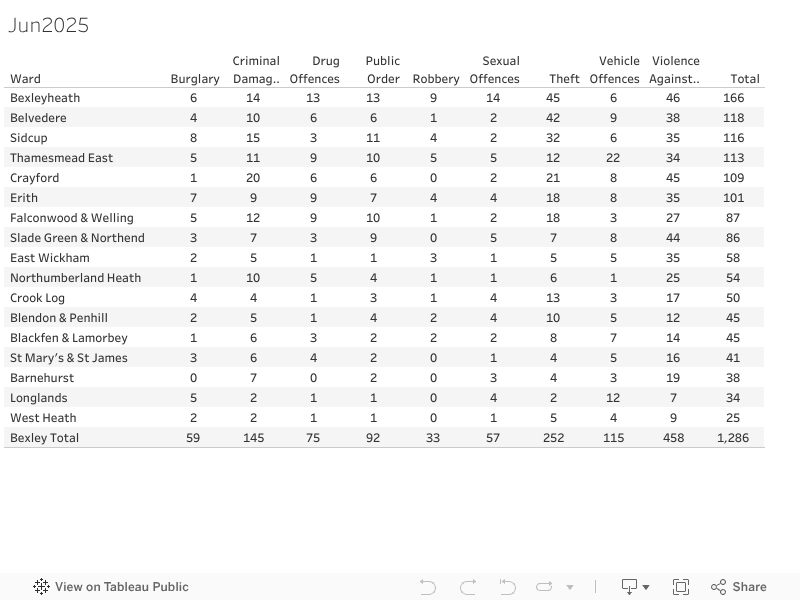
Bexley Crime stats ward summary Jun 2025

5 most convincing scams of 2025

The most believeable scams often exploit our everyday needs and worries, with fraudsters looking for a coincidental opportunity that catches you out on a busy day.

The usual warning signs are getting harder to spot, so take a look at the five most convincing scams this year and follow our advice on what to watch out for.

Hard-to-spot scams

Source: Which? (03 July 2025) 

Marks and Spencer impersonation scam

Following the recent cyberattack, M&S has been offering some customers an e-gift card as a goodwill gesture for the disruption. However, customers should be cautious after reports of scam emails circulating.

We examine the scam emails claiming to be from M&S and explain how you can spot a genuine email.

Stay alert to M&S scams

Source: Which? (01 July 2025) 

Watch out for fake 'energy support' scams

After the recent Winter Fuel Payment announcements, scammers have been busy impersonating the Department for Work and Pensions.

Dodgy messages include scam links to websites designed to steal your personal and financial information. We round up the various versions of these scam texts so you don't get caught out.

See the examples

Source: Which? (02 July 2025) 

Which? scams podcast special

In a special episode of our podcast, Lucia Ariano sits down with Which? scams and consumer rights editor Lauren Deitz, fraud expert Faye Lipson and privacy expert Andy Laughlin to answer your questions and give their top tips to help protect you and your loved ones from scams.

Listen to our experts

Source: Which? (24 Jun 2025) 

⚠️ Current UK Cyber Threat Landscape: Phishing Trends to Watch 2025 🇬🇧

While the classic "mailbox full" scam is still used, cybercriminals in the UK are using much more sophisticated tactics right now....